Care & Logistics
How to Measure for Furniture Delivery (Doorways, Stairs, Elevators)
7 min read
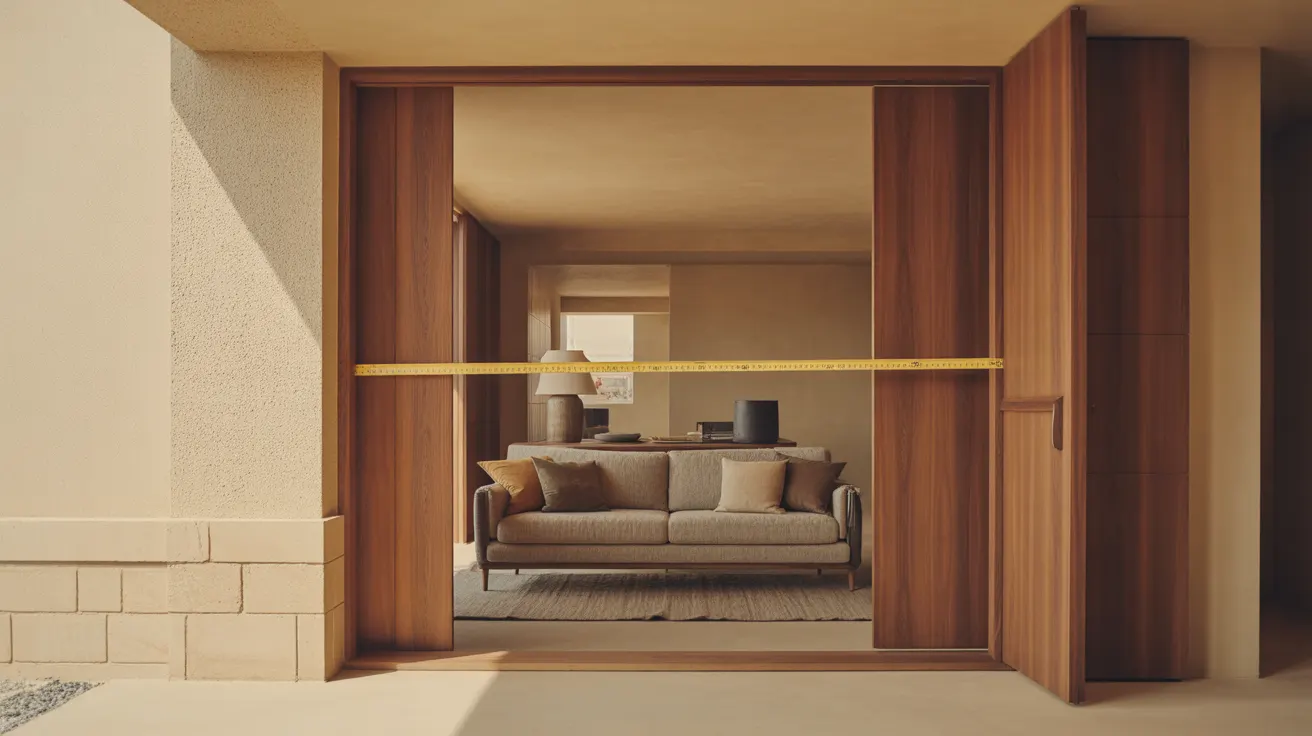
Will your sofa fit? A step-by-step guide to measuring your delivery path — doorways, hallways, stairwells, elevators, and ceiling clearance — with a checklist.
The question every large-furniture buyer should ask before checkout isn't "does this fit my room?" — it's "can this get to my room?" Plenty of perfect sofas end up returned not because they're wrong, but because they can't make the turn at the top of the stairs. Measuring your delivery path takes about fifteen minutes and saves a great deal of frustration. This guide walks through every point on the journey — doorways, hallways, stairwells, elevators, and ceiling clearance — with a checklist you can carry from the curb to the corner where the piece will live.
Start with the two numbers that matter most
Furniture moves through tight spots in one of two ways: flat through an opening, or tilted and turned around a corner. So before you measure your home, measure the piece. From the product page, write down its packaged dimensions (the boxed size, which is what actually travels) and its unpackaged dimensions, plus the diagonal depth for anything bulky.
Diagonal depth is the measurement movers care about most for sofas and large chairs, because pieces are usually angled to get through doors. To find it, measure from the highest point of the back frame diagonally down to the front of the arm or seat. That diagonal — not the full height or full depth — is often the true bottleneck. If the product page doesn't list it, you can estimate it, or ask before you buy.
Then measure your path and compare. The rule is simple: at every point, the opening must beat the relevant furniture dimension, with a couple of inches to spare for hands, blankets, and maneuvering.
Step by step: measuring the whole path
Walk the route the delivery will actually take, from the truck's likely parking spot to the final wall, and measure each obstacle in order. Bring a tape measure, a notepad, and a second person if you can.
1. Doorways and entry doors
Measure the width of each doorway at its narrowest — that's the clear opening with the door open, not the frame. If the door can be removed from its hinges, note the few extra inches that buys you. Measure the height too, and don't forget the front entrance, any storm or screen door, and interior doors along the route.
2. Hallways and turns
Measure hallway width, then look for the real challenge: corners. An L-shaped turn from a narrow hall into a doorway is where furniture gets stuck. For a 90-degree turn, the space you need depends on both the hallway width and the piece's length and diagonal depth — tight turns may require a piece short enough to pivot. Note any low-hanging light fixtures, wall sconces, or thermostats that narrow the path.
3. Stairwells
Stairs are the most common deal-breaker. Measure the width of the staircase between walls or railings, the ceiling height above the stairs (especially on landings, where a piece must tilt up to round the turn), and the depth of any landing where movers need to pivot. A straight run of stairs is far friendlier than a switchback with a tight landing. Spiral and very steep staircases often rule out large rigid pieces entirely.
4. Elevators
If the piece is going up by elevator, you need three numbers: the door opening (width and height), the interior depth and width of the cab, and the interior height — because a tall piece may have to stand on end. A piece that fits through the doors can still be defeated by a cab that's too shallow to hold it upright. Confirm whether your building has a freight elevator and any reserved move-in hours.
5. Ceiling clearance and tight verticals
Finally, check the ceiling height anywhere a piece must be tilted upright — at the bottom and top of stairs, inside an elevator, and in the destination room. Low ceilings, soffits, and the underside of a stair turn can stop a tall headboard, armoire, or bookcase even when every doorway clears.
Your delivery-path measurement checklist
Measure each point along the route and compare it to the relevant furniture dimension. Leave at least 2 inches of clearance everywhere for hands and maneuvering.
| Checkpoint | What to measure | Compare against | Clearance tip |
|---|---|---|---|
| Entry / front door | Clear width and height (door open) | Packaged width or diagonal depth | Removing the door adds ~2 in. of width |
| Doorways (interior) | Narrowest clear width and height | Diagonal depth (sofas/chairs) | Tilting often clears a tight door |
| Hallways | Width, plus any 90° turn | Piece length + diagonal depth | Short pieces pivot in tight turns |
| Stairwells | Stair width, ceiling above, landing depth | Width and diagonal depth | Switchbacks need landing space to turn |
| Elevator | Door opening + cab depth, width, height | Largest packaged dimension | Tall pieces may need to stand on end |
| Ceiling clearance | Height where piece must tilt upright | Piece height when angled | Check stair turns and the final room |
A low-tech trick that beats any spreadsheet: cut a cardboard box or tape a paper outline to the piece's packaged dimensions and physically carry it along the route. If the mock-up makes every turn, the furniture will too. For the final room itself — how the piece sits once it's in — our sofa dimensions guide covers seat depth, walkways, and proportion.
When the path is tight: your options
If the numbers don't clear, you have more options than "give up."
- Choose modular or knock-down designs. Sectionals that ship in sections and pieces with removable legs or feet pass through openings that one-piece furniture can't. This is the single best fix for tight homes.
- Remove doors and obstacles. Taking doors off their hinges and clearing wall fixtures temporarily can buy the inches you need.
- Use an alternate route. A patio door, a balcony, or a ground-floor window sometimes succeeds where the front stairs fail.
- Consider professional hoisting as a last resort for high-rise apartments — specialty movers can lift pieces through windows, though it's a significant added cost.
Inspect on arrival
When the piece arrives, open the packaging promptly and check the frame, legs, seams, and finish before the crew leaves if you can. Photograph any transit damage right away — documented damage is far easier to resolve than something discovered weeks later. Keep the packaging until you're certain the piece is staying. For a fuller pre-purchase routine that pairs with this one, see our guide to buying furniture online with confidence.
The short version
Before you buy anything large, measure the path, not just the room. Note the piece's packaged dimensions and diagonal depth, then measure every doorway, hallway turn, stairwell, elevator, and the ceiling height anywhere the piece must tilt upright — leaving 2 inches of clearance throughout. A cardboard mock-up carried along the route is the surest test. Fifteen minutes with a tape measure prevents the most avoidable return in furniture.
Confident the piece will get there? Make sure it fits the room too with our sofa dimensions guide, and shop pieces — including modular designs made for tight delivery paths — in our sofa collection.
Frequently asked questions
How do I know if my sofa will fit through the door?
Compare the sofa's diagonal depth — measured from the top of the back frame down to the front of the arm — against the doorway's clear width with the door open. Diagonal depth, not the full height or depth, is usually the real bottleneck, because sofas are angled through doors. The sofa door fit calculator runs the check, with the 2 inches of clearance.
What is diagonal depth and why does it matter?
Diagonal depth is the straight-line measurement from the highest point of a piece's back to the front of its seat or arm. It matters because movers tilt furniture to get it through openings, so this diagonal is often smaller than the full depth or height and determines whether a piece actually clears a door.
Do I really need to measure stairwells and elevators?
Yes, if the piece is going above the ground floor. Stairwells — especially switchbacks with tight landings — and shallow elevator cabs are the most common reasons a delivery fails. Measure stair width, ceiling clearance above the stairs, landing depth, and the full elevator interior.
What if the furniture won't fit my delivery path?
Look at modular or knock-down designs that ship in sections or have removable legs, remove doors temporarily, try an alternate entrance, or, for high-rises, ask about professional hoisting. Confirming the return policy before ordering also turns a failed fit into an inconvenience rather than a loss.
How much clearance should I leave when measuring?
At least 2 inches at every point along the path — for hands, padding, and the angle needed to turn a piece. Tighter than that and a delivery becomes risky even when the raw numbers technically match.