Sizing Guides
Floor Lamp Buying Guide: Height, Light, and Placement
6 min read
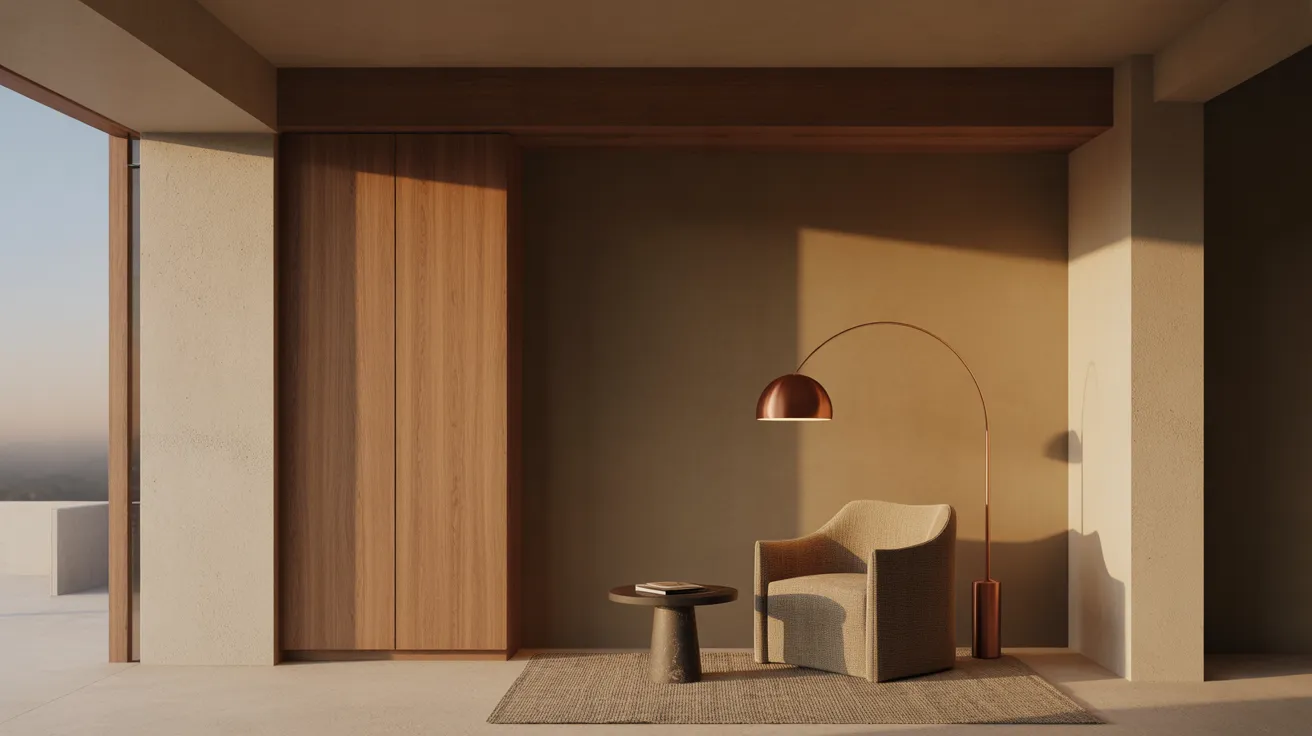
A practical floor lamp buying guide: ideal heights in inches, where to place reading lamps, and how to match lamp scale to your seating and room.
Most floor lamps stand between 58 and 64 inches tall, and that range works for the majority of living rooms. The more useful rule is about the shade: for reading, the bottom of the shade should sit at or just below your seated eye level — roughly 40 to 42 inches from the floor — so light falls on the page, not in your eyes. Choose the lamp's job first (reading, ambient glow, or accent), then let height, shade, and placement follow.
Here's how to get all three right.
First, decide what the lamp is for
A floor lamp can do three different jobs, and each one points to a different design:
- Task light — focused, directional light for reading, knitting, or a desk corner. You want a shade or head that aims downward, positioned close to where you sit.
- Ambient light — a soft wash that fills the room and takes pressure off the overhead fixture. Torchieres and diffused-shade lamps do this best.
- Accent light — a quieter glow that warms a corner, grazes a textured wall, or marks the edge of a seating zone in an open plan.
Most rooms feel best with at least three light sources at different heights. If your living room currently runs on one ceiling light, a floor lamp is the fastest, no-drill fix — and the thinking behind it is covered in our guide to layered lighting.
How tall should a floor lamp be?
Use the table below as your starting point. Heights are measured from the floor to the top of the lamp unless noted.
| Lamp type / use | Recommended overall height | Key measurement |
|---|---|---|
| General living room lamp | 58–64 in. | Bottom of shade at or just below standing eye level when nearby |
| Reading lamp (beside a chair or sofa) | 47–60 in. | Bottom of shade 40–42 in. from the floor — near seated eye level |
| Torchiere (uplight) | 66–72 in. | Light bounces off the ceiling; works best with 8 ft+ ceilings |
| Arc floor lamp | 60–80 in. at the peak | Shade hangs 24–36 in. above sofa-arm height; reach of 30–48 in. clears the seat below |
| Desk-side task lamp | 50–58 in. | Head adjustable to land light on the work surface, not the monitor |
Two sanity checks before you buy:
- Ceiling height. With standard 8-foot ceilings, keep lamps under about 72 inches so there's visible air above them. Lofty 9- or 10-foot ceilings can carry taller torchieres and dramatic arcs.
- Eye-level glare. Sit where you actually sit, and imagine the bulb at the lamp's listed height. If the bare bulb would be visible from your seat, you want a deeper shade, a diffuser, or a different height.
Placement: where the lamp earns its keep
Beside a reading chair. Place the lamp just behind your shoulder, slightly to one side, with the shade's bottom edge around 40–42 inches high. Light comes over your shoulder onto the page — no shadows from your own head, no glare in your eyes.
Behind a sofa. An arc lamp planted behind one end of the sofa can float light over the seat — useful when there's no room for a side table and lamp. Leave the walkway clear: the base needs about 10–12 inches of floor, and the arc should clear seated head height by a comfortable margin.
In a dark corner. A corner lamp does double duty: it lights the corner and visually pushes the walls outward, making the room read larger. Angle it to graze a textured wall — plaster, wood, a woven hanging — and you get accent light for free.
In an open plan. Use a floor lamp to mark a zone: one beside the reading chair, separate from the dining pendant, separate from the kitchen task light. The pools of light tell you where each "room" begins, even without walls.
Next to a desk. If your workspace shares the living room, a slim task floor lamp tucks beside the desk without claiming surface area. Aim the head at the desktop, not at the screen.
Scale: matching the lamp to your furniture
A lamp doesn't live alone; it lives next to a sofa, a chair, a shelf. A few proportions that consistently look right:
- Next to seating, the bottom of the shade should land somewhere between the sofa's arm height and seated eye level. Shades floating far above the sofa feel disconnected; shades below arm height feel sunken.
- If a table lamp lives nearby, keep the floor lamp's shade no more than about 6–12 inches above the table lamp's shade. Wildly different shade heights make a room feel restless.
- Visual weight matters as much as height. A heavy sculptural base suits a deep, grounded sofa; a thin stem reads better beside lighter, leggier furniture.
Browse with the room in mind, not just the lamp — the silhouettes in our floor lamps collection range from slim stems to sculptural bases for exactly this reason.
Bulbs, brightness, and warmth
The lamp is the fixture; the bulb is the light. Two numbers to check:
- Lumens (brightness). For ambient or accent light, 400–800 lumens per lamp is plenty. For serious reading, aim for 450 lumens or more landing on the page — which usually means a 800+ lumen bulb in a downward-facing shade.
- Color temperature. For living spaces, 2700K–3000K ("warm white") flatters wood, linen, and skin. Cooler temperatures (4000K+) belong in workshops, not living rooms.
A dimmer — built into the lamp or added at the plug — turns one lamp into three moods. If you only adopt one upgrade from this guide, make it that one.
Shop this guide
- 66" Bronze Adjustable Arc Floor Lamp With Bronze Dome Shade
- Gold Metal Adjustable Tripod Floor Lamp
- 61" Brown Three Light Traditional Shaped Floor Lamp
The short version
Pick the job first: task, ambient, or accent. For reading, put the bottom of the shade at 40–42 inches — seated eye level — just behind your shoulder. Keep most lamps in the 58–64 inch range under an 8-foot ceiling, let torchieres and arcs go taller, and warm everything with 2700K–3000K bulbs on a dimmer. One good floor lamp won't just light a corner; it will redraw the whole room after dark.
Find the one your reading chair is waiting for — Shop Floor Lamps, or explore the full lighting collection to layer the room properly.
Frequently asked questions
How tall should a floor lamp be next to a sofa?
About 58–64 inches overall, with the bottom of the shade no lower than the sofa's arm and no higher than your standing eye line. For reading specifically, keep the shade bottom around 40–42 inches from the floor.
Where should I put a floor lamp for reading?
Just behind your shoulder, offset to one side of the chair, so light falls over your shoulder onto the page. Avoid placing it directly in front of you (glare) or directly behind your head (shadow).
Can a floor lamp light a whole room?
A torchiere bouncing 1,500+ lumens off a light-colored ceiling can carry a small room, but most spaces feel better with two or three sources — a floor lamp plus a table lamp plus the overhead, each doing a different job.
Do floor lamps need to match the other lamps in the room?
No — but they should agree. Repeat one element (a metal finish, a shade fabric, a shared warmth of bulb) and let the shapes differ. Matching everything reads like a showroom; matching nothing reads like a dorm.
What wattage or lumen bulb should I use in a floor lamp?
For ambient light, an LED bulb of 400–800 lumens (roughly a 40–60W equivalent). For reading, 800–1,100 lumens with a shade that directs light downward. Always stay within the fixture's rated maximum.