Comparisons
How to Style a Bookshelf Without It Looking Cluttered
6 min read
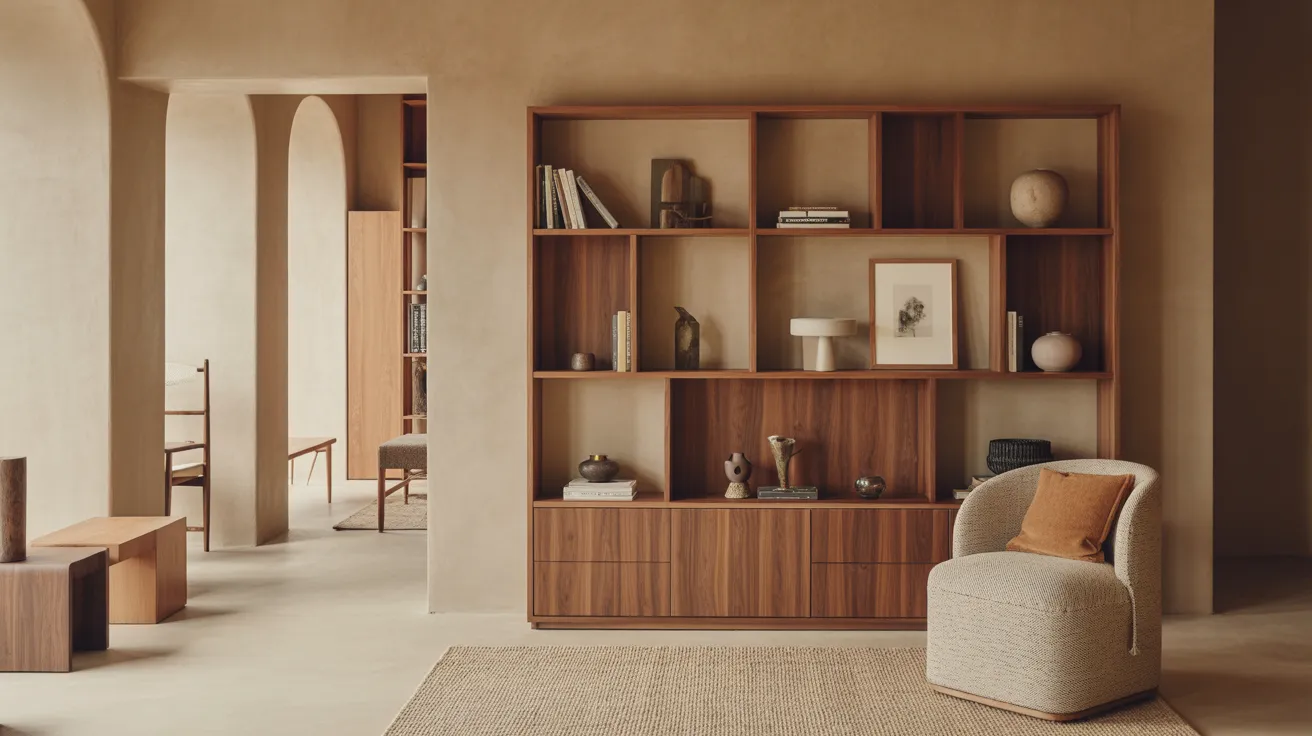
Style a bookshelf that looks calm, not chaotic. The 60/30/10 fill rule, how to mix horizontal and vertical books, and shelf-by-shelf placement.
A bookshelf reads as cluttered when every shelf is full and everything sits at the same height. The fix is counterintuitive: take things off. A styled shelf is mostly about negative space — about 30 percent of each shelf left empty — plus a deliberate mix of horizontal and vertical stacks, a few objects with breathing room, and color kept calm. This guide gives you a repeatable system you can run shelf by shelf.
The mindset shift: edit first, then arrange
Before you place a single object, clear the shelves completely and sort everything into three piles: books you'll display, objects you love, and things that are just stored there. That last pile is the problem. Storage and styling are different jobs — if a shelf has to hold every paperback you own, it can't also look composed. Move the overflow elsewhere (a closet, a closed cabinet, a different room) and style only what's left.
This is also the moment to decide whether your shelving is even right for the look you want. Open shelving shows everything; closed or part-closed units hide the clutter you can't part with. If you're still choosing the unit, our bookcase buying guide covers depth, open-versus-closed, and proportion before you commit.
The 60/30/10 fill rule
Think of each shelf as a small composition with three ingredients in rough proportion:
- 60% books — your bulk and your color, in a mix of vertical rows and horizontal stacks.
- 30% empty space — the breathing room that makes everything else look intentional.
- 10% objects — a sculpture, a bowl, a small frame, a plant. The accents that keep it from looking like a library shelf.
You don't measure this with a ruler — it's a feel. But if a shelf is 100 percent full, you've lost the empty space that does the styling. When in doubt, remove one more thing.
Mix horizontal and vertical
The single biggest upgrade to a bookshelf is breaking the wall of upright spines. Stand some books vertically in a row, lay others in a short horizontal stack of three to five, and the rhythm changes from monotonous to designed.
The horizontal stacks earn their keep twice over. They create a visual pause between vertical runs, and the top of a stack becomes a pedestal — set a small object, a candle, or a bookend on it and you've added height variation without adding clutter. Aim for at least one horizontal element on most shelves, but vary which side it lands on so the stacks don't line up in a column down the unit.
Work in groups and triangles
Objects look best in odd-numbered groups — threes and fives — clustered with a little space around the group. A lone object on a wide shelf looks stranded; a tight trio looks curated. Vary the heights within each group so the eye travels: a tall stem, a medium frame, a low bowl.
Across the whole unit, place your eye-catching pieces in a loose triangle rather than a straight line or a symmetrical grid. One bold object top-left, another center-right, a third bottom-left, and the eye moves diagonally through the piece instead of scanning rows. This is the same triangle principle that styles a coffee table or a mantel — it works because it gives attention somewhere to go.
Calm the color
Cluttered often means chaotic color, not too many objects. A few ways to settle it:
- Turn some spines inward. Pages-out gives a soft, uniform off-white that reads as calm and lets your objects stand out. Do a few shelves or a few stacks, not necessarily all of them.
- Group books by color in loose blocks rather than scattering bright spines randomly.
- Limit your object palette to two or three tones that echo the room — warm wood, off-white ceramic, a single accent metal.
- Repeat one material across the shelves (woven, stone, brass) so the unit feels collected rather than accumulated.
You don't need everything to match. You need it to relate.
Shelf-by-shelf placement guide
Use these targets as a starting framework, then adjust to what you own.
| Shelf zone | What works | Why |
|---|---|---|
| Eye-level shelf | Your best object + a balanced book mix | This is what people see first — give it the strongest grouping |
| Top shelf | Taller items, a trailing plant, one large piece | Draws the eye up; avoids a top-heavy crowd of small things |
| Middle shelves | Alternating vertical rows and horizontal stacks | Carries the bulk of the books with built-in rhythm |
| Bottom shelf | Heaviest, largest items; baskets for storage | Visual weight belongs low; baskets hide overflow |
| Every shelf | ~30% left open; one height change | Negative space and varied heights prevent the cluttered look |
A few extra rules of thumb: keep the heaviest visual weight toward the bottom so the unit feels grounded; let a plant trail from a high shelf to soften hard edges; and if the bookcase has a back panel, a paint color or wallpaper behind the objects adds depth without adding stuff.
A quick worked example
Picture a five-shelf bookcase. Top shelf: one large vase off to the left, a trailing pothos on the right, the center left open. Eye-level shelf: a vertical run of books with spines out on the left, a horizontal stack of four pages-in books on the right with a small stone sculpture on top, a gap between them. Two middle shelves: alternating vertical and horizontal book groupings, one framed print leaning at the back of each. Bottom shelf: a row of large hardcovers and two woven baskets for the overflow you didn't want on display. The eye-catching objects — the vase, the sculpture, a brass bowl on a middle shelf — form a loose triangle down the unit. Roughly a third of every shelf stays open.
Most of the accents here — vases, bowls, small frames, bookends, baskets — are single decor pieces, not sets. Browse decor and accents and choose two or three repeating materials rather than a matched collection.
Shop this guide
- 5" Black Marble Tabletop Sculpture
- 16" Off White Cylinder Ceramic Table Vase With Handles
- 5" x 7" Gray Wood Tabletop Picture Frame
The short version
- Edit before you arrange: display your favorites, store the overflow elsewhere.
- Aim for roughly 60% books, 30% empty space, 10% objects per shelf.
- Mix vertical rows with horizontal stacks; use stack tops as pedestals.
- Cluster objects in odd-numbered groups and place eye-catchers in a loose triangle down the unit.
- Calm the color — turn some spines in, repeat two or three materials, keep the palette tied to the room.
Starting from scratch or upgrading the unit itself? Shop Bookcases for open and closed shelving sized to the room and the look you're after.
Frequently asked questions
How do you style a bookshelf so it doesn't look cluttered?
Edit first — remove anything that's only being stored — then leave about 30 percent of each shelf empty. Mix vertical and horizontal book groupings, cluster objects in odd-numbered groups, and limit your colors and materials so the unit relates to itself.
Should books be horizontal or vertical on a shelf?
Both. Vertical rows carry the bulk; horizontal stacks of three to five create visual pauses and double as pedestals for small objects. Vary which side the horizontal stacks land on so they don't form a column.
Should you turn books backwards on a shelf?
Turning some spines inward gives a calm, uniform off-white that lets objects stand out — a good move if your spines are visually noisy. You don't have to do it everywhere; a few stacks or shelves is enough.
How much empty space should a styled shelf have?
Roughly 30 percent. Negative space is what makes the rest look intentional. If a shelf is completely full, remove one or two items until it breathes.
What objects go on a bookshelf besides books?
Sculptural pieces, bowls, small framed prints leaned at the back, candles, a trailing plant, and baskets for overflow on the bottom shelf. Use them at about 10 percent of each shelf and group them in odd numbers.
How do you style a bookshelf with too many books?
Move the overflow off the open shelves entirely — into baskets, a closed cabinet, or another room. A bookcase can store everything or look styled, rarely both. Display your favorites and your best objects; store the rest out of sight.