Comparisons
Round vs. Rectangular Dining Table: How to Decide
6 min read
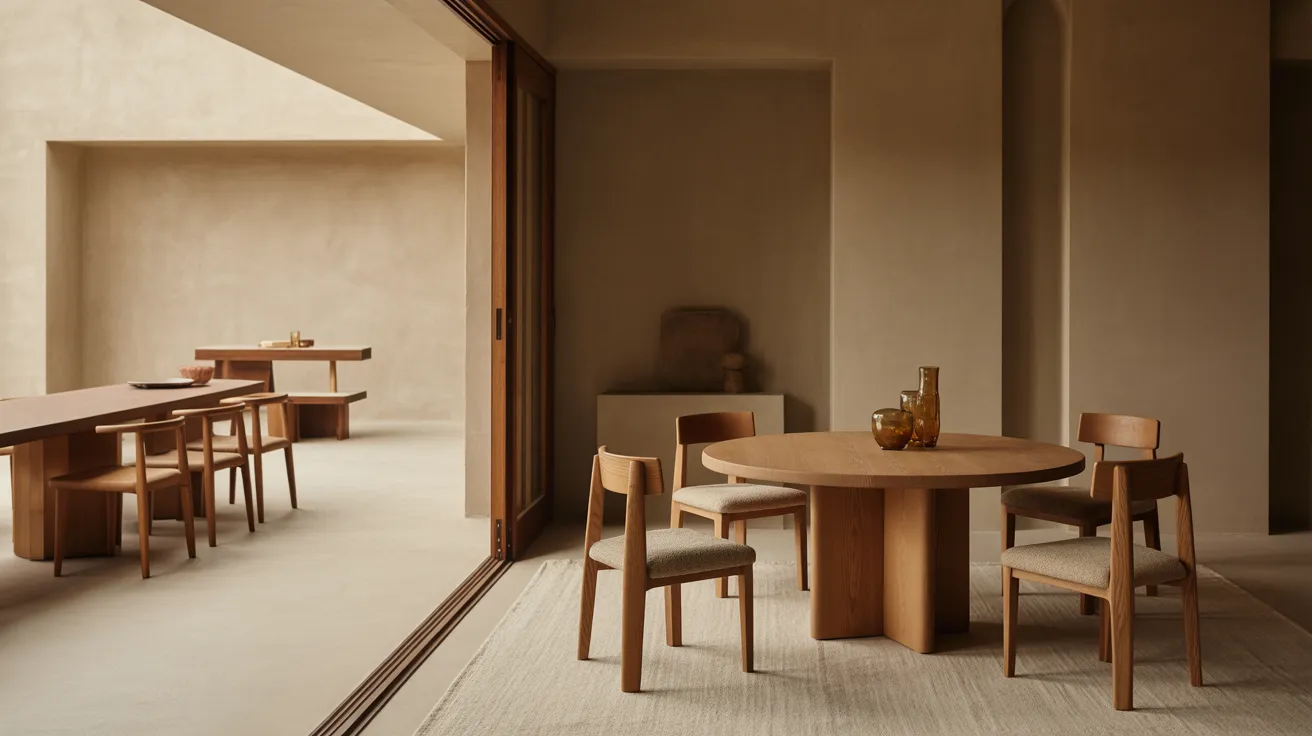
Round or rectangular dining table? Compare seating, clearance, and room shape with real measurements so your next table actually fits your space.
The short answer: let your room decide. Square-ish rooms and small spaces favor round tables — they fit corners-free spaces better, seat people more flexibly, and soften traffic flow. Long or narrow rooms, big households, and frequent hosts favor rectangular tables, which seat more people per square foot of room and suit how most dining rooms are shaped. Neither is more "correct"; one of them simply argues less with your floor plan.
Start With the Room, Not the Table
Dining tables fail for one reason far more than any other: not the wood, not the style — the clearance. You need about 36 inches from the table edge to the nearest wall or furniture just to slide a chair out and sit down, and 42–48 inches wherever people walk behind seated diners. Run that math before you fall in love with anything.
Here's why shape matters so much: a rectangular table concentrates its clearance needs along two long sides, which is exactly what a rectangular room provides. A round table needs that clearance in every direction — which is why it thrives in square rooms and struggles in narrow ones. Match the table's geometry to the room's, and most of the decision is already made. For the full measurement walk-through, including seats-per-size charts, see our dining table size guide.
Side-by-Side Comparison
| Round Table | Rectangular Table | |
|---|---|---|
| Best room shape | Square or open-plan corners | Long, narrow, or formal dining rooms |
| Seats 4 comfortably | 40–48" diameter | 48–60" long |
| Seats 6 comfortably | 54–60" diameter | 72" long |
| Seats 8 comfortably | 72" diameter (large!) | 96" long |
| Squeezing in one extra guest | Easy — everyone shifts | Harder — fixed sides and corners |
| Conversation | Everyone faces everyone | Splits into ends and neighbors |
| Traffic flow | Excellent — no corners to clip | Corners catch hips in tight rooms |
| Small kids | No corners at eye level | Corner guards, anyone? |
| Expandability | Leaf turns round to oval | Common and effective leaf designs |
| Against a wall / banquette | Loses its advantage | Works beautifully |
| Serving large dinners | Center is far away on big rounds | Long center line fits platters |
The Case for Round
A round table is the most social shape in furniture. Everyone faces everyone; there's no head of the table, no shouting past three neighbors. For households that linger over dinner, that geometry genuinely changes the meal.
Round Tables in Small Dining Rooms
This is where round earns its reputation. A 42–48-inch round table seats four with a smaller total footprint than most rectangular alternatives, and the absence of corners does two quiet favors: walking paths can curve close to the table without bruised hips, and the room reads more open because the eye sweeps past the table instead of stopping at corners. In an eat-in kitchen or a dining nook under 10 x 10 feet, a 42-inch round with a pedestal base (no legs to straddle) is hard to beat.
The honest limits: round stops scaling. A table for eight needs roughly a 72-inch diameter — which demands a room at least 13 feet across once you add clearance, and seats your guests so far apart that passing the salad becomes logistics. Round tables also waste their advantage against a wall; push one into a corner and you lose both seats and the all-facing geometry.
The Case for Rectangular
Rectangular is the workhorse for a reason: it matches the shape of most dining rooms, seats the most people per square foot of floor, and handles the realities of hosting. A 72-inch rectangular table seats six comfortably (allow 24 inches of table edge per person) and fits in a room a 60-inch round simply can't serve. Add a leaf and Thanksgiving is solved.
Rectangular tables also play well with the rest of the room: centered under a linear chandelier, paired with a bench on one side, pushed against a wall or into a banquette when space is tight — flexibility round can't match. In open-plan spaces, a rectangular table's strong lines help define the dining zone the way a sectional defines a living zone.
The trade-offs: corners take up perceptual and literal space in tight rooms, conversation splits into clusters at tables longer than about 84 inches, and a too-large rectangle dominates a small room in a way a round table somehow never does.
Choose Round If / Choose Rectangular If
Choose a round table if:
- Your dining space is roughly square, or it's a corner of an open plan.
- You seat 2–6 people most nights and want conversation to include everyone.
- The room is tight and traffic flows around the table on multiple sides.
- Young kids make corner-free furniture genuinely appealing.
Choose a rectangular table if:
- Your dining room is longer than it is wide — most are.
- You regularly seat 6 or more, or host holidays that swell to 10.
- You want bench seating, a banquette, or a wall-side placement option.
- Your lighting is a linear fixture or a row of pendants.
Worth knowing: an oval table is the genuine compromise — rectangular capacity with round's soft traffic flow — and many round tables extend to oval with a leaf, giving you both shapes in one purchase.
Shop this guide
- 45" Black Solid Wood Pedestal Base Round Top Dining Table
- 63" Walnut Rectangular Dining Table
- Natural Solid Wood Double Pedestal Base Oval Dining Table
The Short Version
Measure your room, then count your chairs. Square room or small space, seating six or fewer: go round — 48 inches for four, 60 for six. Long room, big table nights, or wall-side placement: go rectangular — 72 inches for six, 96 for eight, and always keep 36 inches of clearance to the walls. If you're genuinely split, an extendable round-to-oval table refuses to choose, gracefully.
Found your shape? Shop Dining — filter by shape and size to see what fits the room you just measured.
Frequently asked questions
Does a round table really save space?
For four or fewer seats, yes — a 42–48-inch round occupies less floor and flows better than a comparable rectangle. Beyond six seats the math flips hard: large rounds need wide rooms that rectangles don't.
What size round table fits a 10 x 10 dining room?
Subtract 6 feet (36 inches of clearance per side) from the smaller room dimension: a 10-foot room comfortably hosts a table up to about 48 inches across. That's a true four-seater, five in a pinch.
How many people fit at a 60-inch round vs. a 60-inch rectangular table?
A 60-inch round seats six comfortably, eight snugly. A 60-inch rectangle seats four to six, since only the two long sides hold multiple diners. Round wins per inch of table — but the rectangle needs a smaller room.
Is a pedestal base better than legs?
For round tables, usually yes — a pedestal frees every seat from straddling a leg, which effectively adds a seat at smaller sizes. Check the base's footprint, though; very wide pedestal feet can intrude on foot room.
Can a rectangular table work in a square room?
Yes, if it's modest — a 60–72-inch table centered in a 12 x 12-foot room leaves proper clearance on all sides. What square rooms punish is the long table: anything over 84 inches starts pinching the walkways at the ends.