Comparisons
Modular vs. Fixed Sectionals: Flexibility or Stability?
6 min read
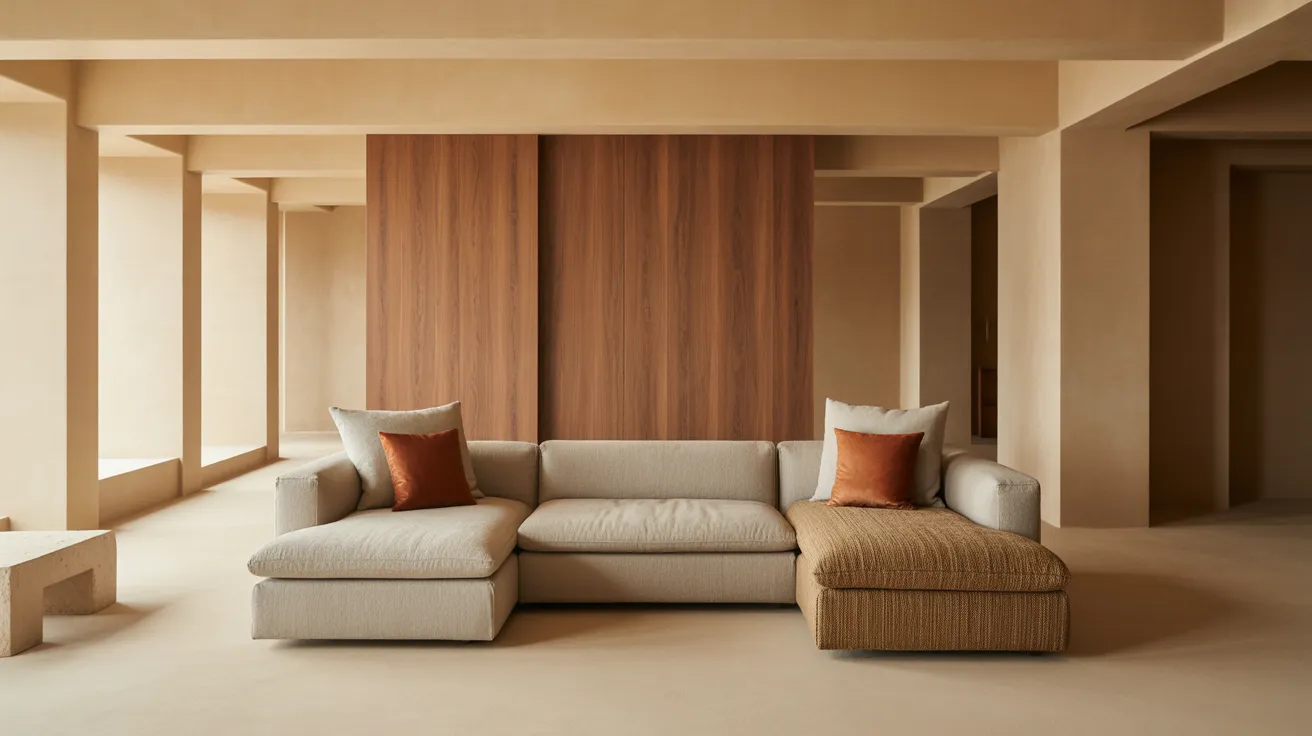
Modular or fixed sectional? Compare flexibility, stability, price, and long-term fit — and find out when a modular sofa is actually worth it.
The short answer: choose a modular sectional if your living situation is likely to change — moves, growing family, evolving layouts — because the ability to reconfigure, expand, and fit through any doorway is genuinely valuable. Choose a fixed sectional if you're settled: it typically gives you a more seamless look, a more solid feel, and more sofa for the money. Modularity is a feature you should pay for only if you'll actually use it.
What "Modular" Actually Means
A fixed sectional arrives in two or three large pre-joined pieces — say, a sofa section and a chaise — that connect once and stay put. The shape you buy is the shape you keep.
A modular sectional is built from independent units: armless seats (typically 28–40 inches wide each), corner pieces, ottomans, and arm modules that latch together in whatever arrangement you choose — and unlatch when you change your mind. An L-shape this year can become a U-shape with two more modules next year, or split into a sofa-plus-ottoman across two rooms after a move.
If you're still deciding whether a sectional is the right call at all, start with our sectional vs. sofa comparison — this article assumes you've landed on sectional and are choosing the construction.
Side-by-Side Comparison
| Modular Sectional | Fixed Sectional | |
|---|---|---|
| Reconfigurable | Yes — L to U to split arrangements | No — shape is permanent |
| Expandable later | Yes, add modules (if the line continues) | No |
| Moving day | Easiest large sofa to move; each module fits stairs and elevators | Large pre-joined pieces; route planning required |
| Visual seamlessness | Visible seams between modules | Cleaner, more continuous lines |
| Stability in use | Good with quality connectors; cheap ones drift and gap | Rock solid |
| Seat-to-seat consistency | Cushions can shift at junctions | Continuous, settled feel |
| Price for equal size | Usually higher — you pay for engineering | Usually lower per inch of sofa |
| Long-term flexibility | High — adapts to new homes and layouts | Low — must fit the next room as-is |
| Risk if your needs change | Low | Resale or replacement |
The Case for Modular: Built for Change
The average American renter moves every few years, and a modular sectional is the rare large purchase that moves with you instead of against you. Each module fits through a standard 30-inch doorway, into elevators, and around stairwell turns that would defeat a 90-inch fixed chaise piece. (If you've ever measured a hallway with dread — our sofa measuring guide exists for that moment — modularity dissolves the problem.)
The flexibility compounds over time. A two-bedroom layout becomes a starter L in the next apartment, then grows into a family-sized U with two added modules, then lends its ottoman to a reading corner. You're not buying a shape; you're buying a seating system.
The honest trade-offs: you'll pay more per seat for the engineering, the seams between modules never fully disappear visually, and quality varies enormously at the connectors. Strong steel latches or interlocking brackets keep a modular sofa feeling like one piece; flimsy clips let modules drift apart on hard floors until you're nudging them back weekly. Connector design is the single spec that separates a great modular from an annoying one — look for metal-on-metal locking hardware and check the weight of individual modules (heavier usually means sturdier frames).
The Case for Fixed: Built to Stay
A fixed sectional is the better object. With no junctions to engineer around, designers give it continuous lines, deeper bench seats, and upholstery that flows unbroken across the full length — that tailored, architectural look that makes a sectional the anchor of a room. It feels different too: no micro-gaps, no module that shifted half an inch, just one settled piece.
It's also, typically, the better value. Without modular hardware and per-module packaging, a fixed sectional usually delivers more sofa — more width, better fill, nicer fabric — at the same spend.
The trade-offs are the mirror image: the shape you choose is permanent, the chaise side (left- or right-facing) is often fixed at purchase, and moving day demands measurement. A fixed sectional fits homes that have stopped changing. That's not a weakness; it's a definition.
Are Modular Sofas Worth It?
Worth it when the flexibility will actually be used — and honestly not when it won't. A useful test: count the moves and layout changes you realistically expect in the next five to seven years.
- Two or more moves, or a growing household: modular pays for itself, possibly twice — once in moving logistics, once in reconfiguration.
- Zero or one move, settled room: you'd be paying a premium for hardware you'll never unlatch. Put that money into fabric and fill instead.
One more honest caveat: expansion later depends on the maker still producing compatible modules in your fabric. Lines change. If future expansion is central to your plan, buy the extra module up front rather than betting on availability in year three.
Choose Modular If / Choose Fixed If
Choose a modular sectional if:
- You rent, move every few years, or live with narrow doorways, walk-ups, or elevators.
- Your household is growing and the sofa should grow with it.
- You like rearranging — seasonal layouts, movie-night configurations, guest setups.
- You may split the piece across rooms someday.
Choose a fixed sectional if:
- You own or plan to stay 5+ years, and the room layout is settled.
- A seamless, tailored look matters more than reconfigurability.
- You want maximum comfort and quality per dollar.
- You'd rather never think about connectors, gaps, or drifting modules.
Shop this guide
- Black Velvet Modular Curved Two Piece Sectional
- Black Faux Leather L Shaped Two Piece Corner Sectional
- Gray Polyester Modular L-Shaped Two-Piece Sofa and Chaise Sectional
The Short Version
This one comes down to a single question: will your life rearrange this sofa, or won't it? Movers, renters, and growing families should go modular — the reconfigurability and doorway-proof moving are worth the premium, provided the connectors are quality metal hardware. Settled households should go fixed and spend the difference on better fabric and fill. Either way, measure the room first, and remember a 30-day return window gives the decision breathing room once it's actually in your space.
Pick your configuration. Shop Sectional Seating — compare modular and fixed designs side by side, with dimensions listed per piece.
Frequently asked questions
Do modular sectionals come apart or shift during use?
Well-made ones don't — steel locking connectors hold modules as one piece. Budget designs with simple clips can drift on hard floors, especially when people sit down heavily at junctions. Check the connector hardware before buying; it's the spec that matters most.
Are modular sofas comfortable compared to fixed ones?
Module-for-module, comfort depends on the same things as any sofa: frame, suspension, cushion fill. The honest difference is at the seams — you can feel a junction if you sit directly on it. On a quality piece with tight connections, that's a minor note, not a flaw.
Can you add pieces to a modular sectional later?
Usually, if the maker still offers that line and fabric. Dye lots can vary slightly between production runs, so an added module may not match a three-year-old sofa perfectly. If expansion is the plan, buying modules together is the safer route.
Is a modular sectional good for small apartments?
Very — arguably its best use case. Modules pass through tight doors and stairwells that block fixed sectionals, and a compact two- or three-module arrangement can scale up when you move somewhere bigger.
Do modular sectionals cost more than fixed ones?
Generally yes, for equivalent size and quality — the connectors, reinforced module frames, and packaging add real cost. You're buying flexibility; whether that's worth the premium depends entirely on whether you'll use it.
How heavy is each module?
Commonly 40–90 pounds depending on size and frame — heavy enough to stay put, light enough for two people to carry up stairs. That balance is exactly the point.