Comparisons
How to Make a Modern Space Feel Warmer (Without Adding Clutter)
6 min read
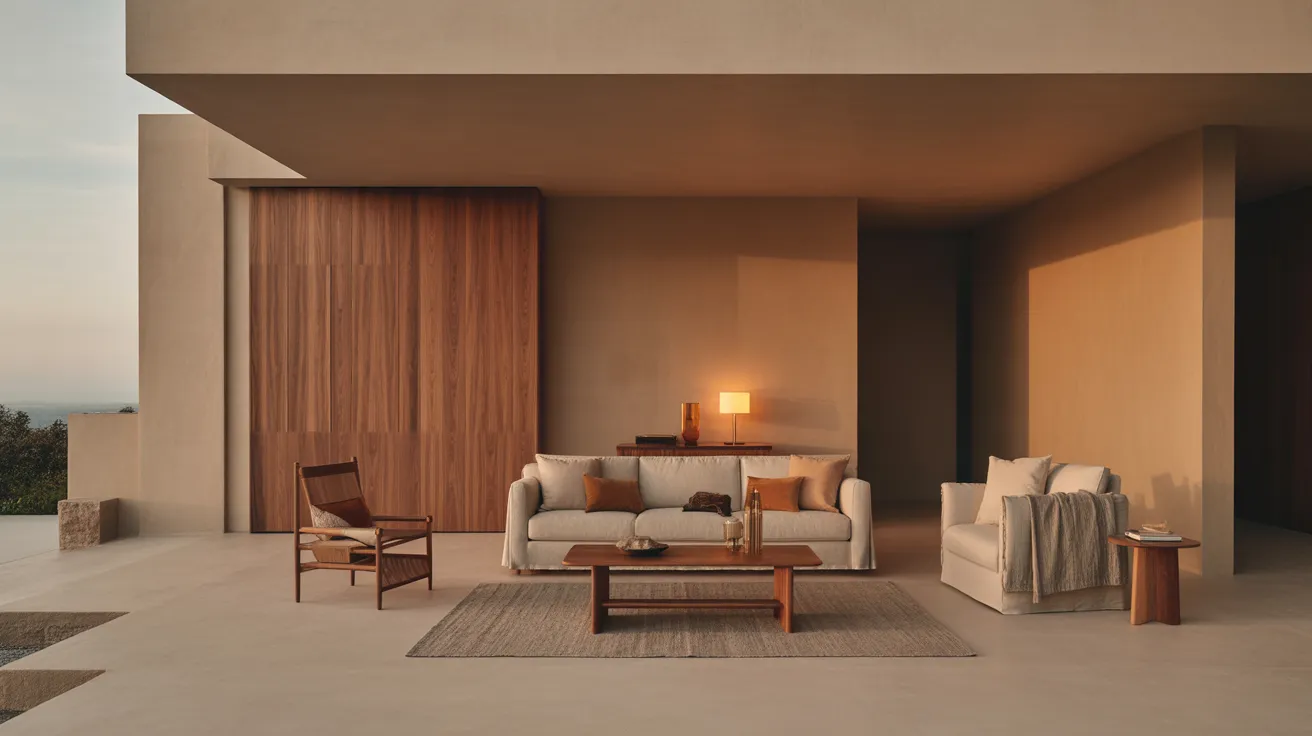
Modern rooms can read cold fast. Warm yours up without clutter using texture, wood tones, layered lighting, and one well-sized rug — a designer's plan.
You chose the clean lines on purpose — the quiet palette, the open floor, the furniture with real architecture to it. So it stings when the finished room reads more "lobby" than "home." Here's the good news: warmth is not the opposite of minimalism, and you can add it without adding a single object you don't love. This is the playbook, move by move.
Why modern rooms read cold in the first place
Cold rooms tend to share the same short list of causes, and "not enough stuff" isn't on it. Hard, smooth surfaces — glass, lacquer, drywall, bare floors — bounce light and sound, which is why a sparsely furnished modern room can feel faintly echoey even when nobody's talking. A single overhead fixture flattens every shadow. A palette built entirely from cool grays has no undertone to catch the late-afternoon light. And when every piece of furniture sits at roughly the same height, the eye glides across the room with nowhere to land.
Notice what that list is really about: materials, light, and movement. Not quantity. You don't fix a cold room by filling it. You fix it by changing what the surfaces are made of, where the light comes from, and how the eye travels.
Six moves that add warmth, not stuff
1. Change the textures before you change the objects
Texture is the fastest warmth you can buy, because it works without taking up any new floor space. Swap a smooth cotton throw for a chunky wool one. Trade slick polyester pillow covers for linen or bouclé. Put a woven tray on the glass coffee table. Each rough or nubby surface absorbs a little light and a little sound, and the room softens in a way most people feel before they can name.
A useful discipline: change one texture per major surface — sofa, floor, walls, tables — rather than piling five textures onto the sofa alone. Same object count. Completely different room.
2. Let wood do the talking
Almost every interior that photographs as "warm modern" leans on visible wood grain somewhere the eye lands first. If your seating, storage, and tables are all painted, upholstered, or metal, introduce one honest wood piece — a coffee table, a bench, an open-shelf bookcase — and let the grain show. Mid-tone woods like walnut and white oak carry the most warmth per square inch; you don't need a wall of paneling to get the effect. One well-placed piece shifts the temperature of everything around it.
3. Rebuild the lighting in three layers
If you only act on one section of this guide, make it this one. A lone ceiling fixture is the single most common reason a furnished room still feels institutional.
Aim for at least three light sources at three different heights: something overhead, something at eye level (a floor lamp beside the seating), and something low (a table lamp on a console or shelf). Choose bulbs in the 2700K range — the warm end of white — and put whatever you can on dimmers. In the evening, turn the overhead off entirely and let the lamps carve the room into pools of light. The architecture stays crisp; the mood doesn't.
If your current fixtures are working against you, browse the lighting collection with those three layers in mind rather than shopping one lamp at a time.
4. Size the rug like you mean it
A too-small rug is the quiet saboteur of modern rooms: it makes generous furniture look like it's floating on a bath mat, and all that exposed hard floor reads cold underfoot and to the eye. The fix is mostly arithmetic.
| Placement rule | The number |
|---|---|
| Sofa legs on the rug | Front legs on, at minimum |
| Rug width vs. the sofa | 6–8" wider on each side |
| Bare floor left at the room's edge | 10–18" |
| Most living rooms | 8x10 or 9x12 |
When the rug connects the seating into one composition — front legs of every piece touching it — the furniture stops being separate objects and becomes a room.
5. Curve something
Modern spaces are built on right angles: window grids, shelf lines, the box of the room itself. One or two curved forms break that grid just enough to relax it. A round or oval coffee table, a barrel-back chair, a drum pendant, an arched floor mirror — any of these gives the eye a soft path through a hard-edged room. You're not abandoning the geometry. You're giving it a counterpoint.
6. Style surfaces in small odd numbers — then stop
Warmth needs evidence of a life being lived, but the line between "lived-in" and "cluttered" is thinner than it looks. The working rule: one to three objects per surface, in varied heights — a stack of books, a ceramic vessel, a small lamp — and at least one surface in the room left completely empty. The empty surface is doing real work; it's what makes the styled ones read as intentional. If you're building this layer from scratch, the decor collection is organized for exactly this kind of slow, deliberate edit.
Warm vs. cluttered: the actual difference
It helps to define terms. Clutter is a quantity problem — too many objects competing for the same attention. Warmth is a depth problem — enough variation in texture, light, and tone that the room rewards a second look. A space with twelve objects can feel sterile; a space with six can feel layered and complete. That's why the moves above add almost nothing to your object count: they change the qualities of what's already there.
This balance — quiet rooms with real warmth — is the heart of warm minimalism, and if you want the full philosophy behind it, our complete guide to warm minimalism goes deeper on palette, materials, and restraint.
Shop this guide
- Ivory Blue And Green Microfiber Leaves Plush Throw Blanket
- Set of Two 8" Clear USB Table Lamps
- 9' X 12' Sky Blue And Blue Floral Area Rug
The short version
- Cold rooms are a materials-light-and-movement problem, not a quantity problem.
- Change one texture per major surface; let wood grain show somewhere prominent.
- Three light sources, three heights, 2700K bulbs, dimmers where possible.
- Rug math: front legs on, 6–8" past the sofa on each side, 10–18" of bare floor at the edges.
- Curve one or two forms to soften the grid.
- Style surfaces in odd numbers of one to three — and leave one surface empty.
When you're ready to add the pieces that carry warmth — the textured throws, the grounding rug, the lamp that changes the evening — Explore the Collection and build the layer your room is missing.
Frequently asked questions
How do I make my living room feel cozy without buying more furniture?
Work the surfaces you have: warmer bulbs (2700K) in lamps at two or three heights, a textured throw and linen pillow covers, and a rug large enough that the sofa's front legs sit on it. Those three changes alter the feel of a room without adding a single piece of furniture.
What colors make a modern home feel warmer?
You don't need to repaint. Shift the accents toward colors with warm undertones — cream instead of stark white, camel, terracotta, ochre, walnut brown — and keep the cool grays as the backdrop. Warmth in small, repeated doses beats one big color commitment.
Why does my apartment feel cold even though it's fully furnished?
Usually it's light and texture, not furniture. One overhead fixture, smooth hard surfaces everywhere, and a small or missing rug will make even a full room feel stark. Add lamps at lower heights, one or two rough textures, and a properly sized rug before buying anything else.
What's the fastest single fix for a cold living room?
Turn off the overhead light and add two warm-bulb lamps — one floor, one table. It costs less than any furniture change and most people notice the difference the same evening.
Can a minimalist room still feel cozy?
Yes — minimalism limits quantity, not warmth. Keep the object count low but vary the materials: wood grain, wool, linen, stone, warm metal. A minimal room with five textures feels cozy; a minimal room with one texture feels like a showroom.