Style & Authority
How to Mix Wood Tones Without It Looking Accidental
6 min read
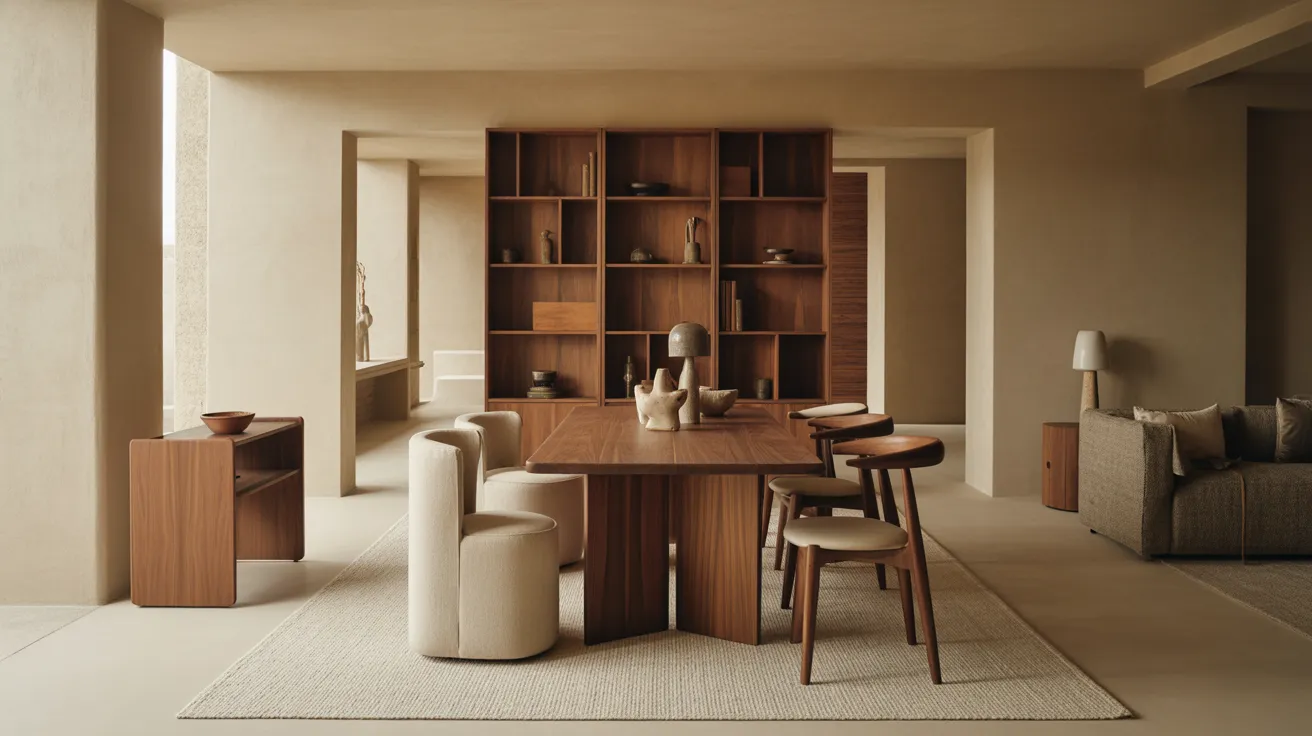
Yes, you can mix oak, walnut, and darker woods in one room. Learn the dominant-tone rule, undertone matching, and simple fixes that make mixed woods look intentional.
You don't need every wood in a room to match — you need them to agree. The rule designers actually use is simple: pick one dominant wood tone, keep every other wood clearly lighter or darker than it, and make sure the undertones (warm or cool) belong to the same family. Matching everything, on the other hand, is how rooms start to look like a furniture showroom from 2004.
Here's how to do it deliberately.
Why matched wood sets fall flat
A room where the dining table, chairs, sideboard, and shelving all share one identical finish reads as flat because nothing has hierarchy. Your eye has nowhere to land. Mixed woods — handled well — create depth the same way mixed textiles do: contrast makes each piece more visible, not less.
There's a practical reason too. Furniture is collected over years. A home where new pieces can only ever match the old ones is a home that gets harder to furnish with every purchase. Learning to mix tones means every future piece has room to belong.
The dominant tone rule
Start by identifying the largest wood surface in the room. Usually that's the flooring; in a carpeted or rug-covered room it might be the dining table or a large bookcase. That's your dominant tone, and it sets the reference point for everything else.
Then follow three steps:
- Let the dominant tone hold the majority. Roughly two-thirds of the visible wood in the room should sit close to it.
- Add contrast on purpose. Choose one or two woods that are clearly lighter or darker — not "almost the same." Near-misses are what read as accidental. A walnut table next to an oak bench looks chosen; a walnut table next to a slightly-different-walnut bench looks like a shipping error.
- Repeat each tone at least twice. A single dark-wood piece in a light-wood room looks stranded. Echo it — a picture frame, a lamp base, a tray — and it becomes a thread instead of an outlier.
Undertones: the part most people miss
Every wood finish leans warm (yellow, orange, red) or cool (gray, ash, taupe). Mixing light and dark woods works easily. Mixing warm and cool undertones is the hard part — that's the combination that feels "off" even when you can't name why.
A quick test: look at the wood in daylight next to something white. Oak with a golden cast, cherry, and most walnuts read warm. Gray-washed, ashed, or espresso-toward-black finishes often read cool.
| If your dominant wood is... | Mixes easily with | Use caution with |
|---|---|---|
| Golden or honey oak (warm) | Walnut, cherry, warm white-oak | Gray-washed and ashed finishes |
| Walnut (warm, mid-dark) | White oak, natural ash, lighter warm tones | Very red mahogany-style finishes |
| Espresso / near-black (neutral-cool) | Almost anything — black acts as a neutral | Honey and orange-heavy tones in large doses |
| Gray-washed / driftwood (cool) | Other muted, low-saturation woods, black metal | Golden oak and cherry |
One useful exception: very dark woods — espresso, ebonized finishes — behave like neutrals. Like black jeans, they go with nearly everything, which makes a dark bookcase or accent table the safest "second wood" you can add to any room. You'll see this logic across our bookcases, where darker irons and woods are designed to sit against lighter floors without arguing.
Buffers: how to make any combination work
When two wood tones meet directly — chair legs on a wood floor, a wood bowl on a wood table — friction shows. The fix is a buffer: something non-wood between them.
- A rug under the dining set separates table legs from flooring and resets the eye. (Size it so chairs stay on the rug when pulled out — our dining table size guide covers the measurements.)
- Textiles on seating — a linen cushion on a wood bench breaks up wood-on-wood stacking.
- Stone, ceramic, or metal objects on wood surfaces keep shelves and tabletops from becoming a single woody mass.
- Painted or upholstered pieces between two wooden ones give each tone its own zone.
This is the same layering logic as mixing materials generally — wood, linen, stone, and warm metal each doing a different job. If that's the part of the room you're still building, the texture pairing approach applies here exactly.
Grain and finish matter as much as color
Two woods of similar tone but very different grain — tight, straight oak next to swirling, open-grain mango wood — still read as distinct, which is what you want. Sheen works the same way: matte and low-sheen finishes mix easily; one high-gloss piece in a room of matte wood will isolate itself no matter how well the color matches.
If a piece you love fights the room, you have options short of replacing it: move it so it isn't touching its nearest wood neighbor, buffer it with textile or stone, or repeat its tone once elsewhere so it stops being the only one of its kind.
A worked example
Say your floors are warm white oak. A sensible build:
- Dominant: the floor, plus a natural-oak dining table — two-thirds majority established.
- Contrast: a walnut sideboard and walnut-framed mirror — darker, clearly different, repeated twice.
- Neutral anchor: a near-black iron-and-wood bookcase — behaves like a neutral, adds weight.
- Buffers: a flatweave rug under the table, linen seat cushions, ceramic and stone objects on the shelves.
Three wood tones, zero matching, nothing accidental.
The short version
- Pick one dominant wood tone — usually the floor or the largest piece — and let it hold about two-thirds of the room.
- Add one or two woods with clear light/dark contrast; avoid near-matches.
- Keep undertones in the same family; treat near-black woods as neutrals.
- Repeat every tone at least twice, and buffer wood-on-wood contact with rugs, textiles, stone, or metal.
Ready to add the contrast piece your room is missing? Explore dining tables and bookcases — warm woods and near-black neutrals designed to mix, not match.
Frequently asked questions
Can I mix oak and walnut in the same room?
Yes — it's one of the most reliable pairings. Both are warm-undertone woods with enough light/dark contrast to look deliberate. Keep one dominant and repeat the other at least twice.
How many wood tones is too many?
Three is comfortable for most rooms; four works in larger, open-plan spaces if one is a near-black neutral. Past that, repetition gets hard and the mix starts to look like clutter.
Should my dining chairs match my dining table?
They don't have to. Contrasting chairs — lighter wood, or upholstered seats with wood legs — often look more current than a matched set. If the table and floor are similar tones, contrasting chairs also act as a buffer.
Do wood floors count as a wood tone?
Absolutely — usually as your dominant tone, since they're the largest surface. Furniture should relate to the floor first, then to each other.
What if my existing furniture is all one matching set?
Break it up gradually. Move one piece to another room, add a clearly contrasting piece (dark if the set is light, and vice versa), and buffer with a rug and textiles. You don't need to replace anything.